



When I started writing SEO content more than 10 years ago, ranking a page was relatively simple.
You could publish a 1,000-word article, add your target keyword several times, build a few backlinks, and often see results within weeks.
Today, the landscape looks completely different.
Google has become significantly smarter. Search engines now evaluate user intent, content quality, expertise, trustworthiness, and topical authority rather than simply counting keywords. At the same time, AI-powered search experiences such as Google AI Overviews, ChatGPT Search, and Perplexity are changing how people discover information online.
Over the last decade, I’ve written content for blogs, agencies, SaaS companies, affiliate websites, local businesses, and eCommerce brands. One thing I’ve consistently noticed is that the highest-performing content isn’t necessarily the longest content or the content with the most keywords.
The content that wins is the content that solves problems better than competing pages.
If your goal is to increase organic traffic, generate leads, and improve visibility in both search engines and AI-powered platforms, this guide will show you exactly how to approach SEO content writing in 2026.
Key Takeaways
- SEO content writing is about helping users, not just search engines.
- Search intent matters more than keyword density.
- AI search rewards clear, structured, authoritative content.
- Topical authority is becoming more important than individual keywords.
- EEAT signals can improve trust and visibility.
- Content should answer questions directly and comprehensively.
- Regular content updates help maintain rankings.
- Entity optimization supports both SEO and AI search performance.
What Is SEO Content Writing?
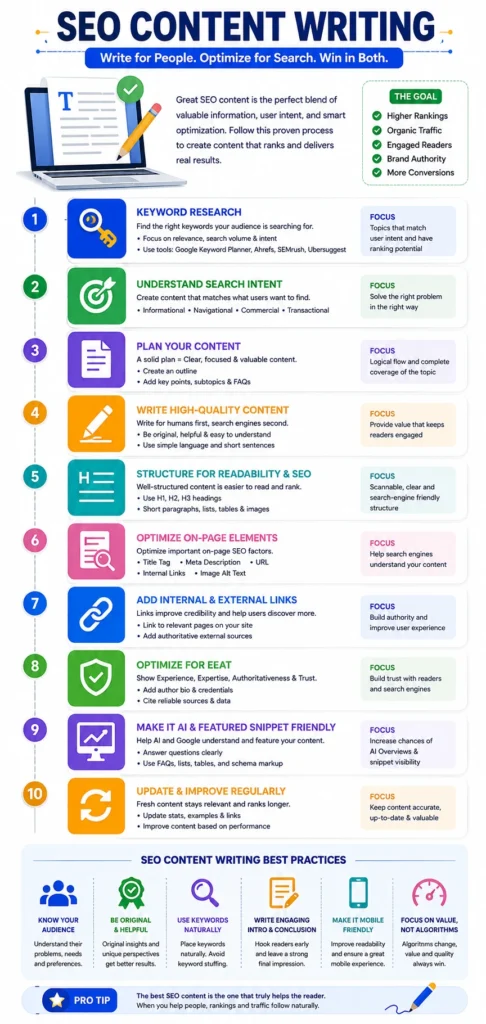
SEO content writing is the process of creating content that helps search engines understand your pages while providing valuable information to users.
The purpose is to create content that:
- Matches user intent
- Answers search queries
- Builds authority
- Encourages engagement
- Supports conversions
- Improves search visibility
Modern SEO content writing combines traditional optimization techniques with user-focused content creation.
In simple terms, SEO content writing helps people find your content and helps search engines understand why it deserves to rank.
Why SEO Content Writing Matters More Than Ever
Millions of blog posts are published every day.
Without proper optimization, even excellent content can struggle to get discovered.
SEO content writing helps:
- Increase organic traffic
- Improve keyword rankings
- Generate qualified leads
- Build brand authority
- Earn backlinks naturally
- Appear in featured snippets
- Get cited in AI-generated answers
As AI search continues to grow, well-structured content becomes even more valuable because answer engines rely on clear and trustworthy information. Valuable content and proper structure also helps you appear in rich snippets.
How to Write SEO Content That Ranks and Appears in AI Search
Start With Search Intent, Not Keywords
One of the biggest mistakes I see writers make is choosing a keyword and immediately starting to write.
Before writing anything, ask:
Why is someone searching for this keyword?
Understanding search intent helps you create content that aligns with user expectations.
Informational Intent
The user wants information.
Examples:
- What is SEO content writing?
- How does SEO work?
Commercial Intent
The user is researching solutions.
Examples:
- Best SEO tools
- SEO writing services
Transactional Intent
The user is ready to take action.
Examples:
- Hire SEO writer
- Buy SEO services
Navigational Intent
The user wants a specific website.
Examples:
- Google Search Console
- Ahrefs Blog
In my experience, content that matches intent often outranks content with stronger backlink profiles but weaker relevance.
Conduct Keyword Research the Right Way
Keywords still matter.
However, modern SEO is about understanding topics and entities rather than obsessing over exact-match phrases.
When researching keywords, focus on:
Primary Keywords
Your main target phrase.
Example:
SEO content writing
Secondary Keywords
Related terms that support the main topic.
Examples:
- SEO copywriting
- Content optimization
- Search engine writing
Long-Tail Keywords
Specific phrases with clear intent.
Examples:
- How to write SEO content
- SEO content writing tips
Question Keywords
These help capture AI Overviews and featured snippets.
Examples:
- What is SEO content writing?
- How do I write SEO-friendly content?
- Does AI-generated content rank?
Create Comprehensive Content Around Topics
Google increasingly rewards topical authority.
Instead of creating dozens of thin articles, build comprehensive resources that cover related subtopics.
For example, a strong article about SEO content writing should naturally discuss:
- Search intent
- Keyword research
- Content structure
- On-page SEO
- Internal linking
- EEAT
- AI optimization
- Content updates
This helps search engines understand your expertise.
Structure Content for Readers and AI Systems
Proper structure improves readability and search visibility.
Use Clear Headings
Organize content with logical heading hierarchies.
Write Short Paragraphs
Large text blocks reduce engagement.
Answer Questions Early
Provide direct answers before expanding.
This improves visibility in:
- Featured snippets
- AI Overviews
- Voice search
- ChatGPT Search
Use Lists When Appropriate
Lists help search engines identify key points quickly.
Focus on EEAT
Google evaluates content based on Experience, Expertise, Authoritativeness, and Trustworthiness.
To strengthen EEAT:
- Share personal experiences
- Include real examples
- Reference reliable sources
- Demonstrate industry knowledge
- Maintain factual accuracy
Over the years, I’ve found that adding genuine insights and practical examples often produces better engagement than simply repeating information available elsewhere.
Optimize for AI Search Engines
AI search is changing content discovery.
To improve visibility:
Answer Questions Clearly
Provide concise answers near the beginning of sections.
Include Relevant Entities
Mention important concepts, tools, brands, and industry terms naturally.
Cover Related Questions
Address follow-up questions users may have.
Maintain Topical Depth
AI systems often prefer comprehensive content that covers a subject thoroughly.
Use Natural Language
Write the way people ask questions.
This increases relevance for conversational search.
Write Naturally Instead of Chasing Keyword Density
Many writers still worry about keyword density.
After more than a decade in SEO, I’ve learned that forcing keywords into content almost always hurts readability.
Instead:
- Use natural language
- Include synonyms
- Cover related concepts
- Focus on answering questions
If your content comprehensively addresses a topic, relevant keywords will appear naturally. I often use Zuhio Keyword Count Checker to avoid keyword stuffing.
Internal Linking Matters
Internal links help search engines discover content and understand relationships between pages.
Benefits include:
- Better crawling
- Stronger topical authority
- Improved user experience
- Increased page views
Every article should link to related resources whenever relevant.
Update Content Regularly
SEO content is not a one-time project.
Content that performed well two years ago may no longer meet current search expectations.
Regular updates should include:
- New statistics
- Fresh examples
- Updated screenshots
- Improved structure
- Additional FAQs
Content freshness can improve both search and AI visibility.
Common SEO Content Writing Mistakes
Avoid:
- Writing without keyword research
- Ignoring search intent
- Keyword stuffing
- Thin content
- Weak headings
- No internal links
- Outdated information
- Publishing without optimization
These mistakes often prevent otherwise good content from reaching its full potential.
The Future of SEO Content Writing
SEO content writing is moving toward a user-first and AI-friendly model.
The future belongs to content that:
- Demonstrates expertise
- Answers questions directly
- Covers topics comprehensively
- Uses clear structure
- Provides genuine value
Writers who focus on helping users rather than manipulating algorithms will continue to succeed regardless of future search updates.
Write for Users, Search Engines and AI Systems
SEO content writing has evolved far beyond keywords and rankings.
Today’s successful content combines user intent, topical authority, EEAT principles, and AI-friendly structure to create resources that genuinely help readers.
After more than a decade of writing and optimizing content, I’ve found that the most effective strategy remains surprisingly simple: create the best answer available for your audience.
When you focus on solving problems, demonstrating expertise, and organizing information clearly, both search engines and AI systems become much more likely to recommend your content.
The goal isn’t simply to rank: The goal is to become the most helpful result for the people searching.
People Also Ask
What is SEO content writing?
SEO content writing is the practice of creating content that helps search engines understand your pages while providing valuable information to users.
How do I write SEO-friendly content?
Start with keyword research, understand search intent, create comprehensive content, use proper headings, and optimize for readability and user experience.
Is SEO content writing still important in 2026?
Yes. SEO content writing remains essential for driving organic traffic and improving visibility in both traditional search engines and AI-powered search platforms.
Does AI-generated content rank on Google?
AI-generated content can rank if it is accurate, helpful, original, and demonstrates expertise. Content quality matters more than how the content was created.
What is the difference between content writing and SEO content writing?
Content writing focuses on engaging readers, while SEO content writing combines engagement with optimization techniques designed to improve search visibility.
How long should SEO content be?
There is no ideal word count. The best content length depends on search intent and how thoroughly the topic can be covered.
What are the most important SEO content writing factors?
Search intent, content quality, topical authority, EEAT, internal linking, and content structure are among the most important factors today.