


The way people search online has changed dramatically over the last few years. Search engines are no longer limited to understanding text queries alone. Today, users can upload screenshots, scan products with smartphones, search using photos instead of words, and even identify objects in real time through AI-powered visual recognition systems.
This shift has made image search techniques far more important than they were in the past. What used to be a simple Google Images lookup has evolved into an advanced ecosystem powered by computer vision, machine learning, metadata analysis, and multimodal AI systems.
Modern search engines now understand visual context almost the same way humans do. They can recognize objects, detect landmarks, analyze text inside images, compare patterns, and even identify altered versions of the same image across the internet.
For businesses, marketers, journalists, researchers, and SEO professionals, understanding image search techniques is no longer optional. It directly affects visibility, content discovery, brand protection, and even credibility online.
In this detailed guide, you will learn how image search works, the most effective image search methods, the best reverse image search tools, advanced visual search strategies, and how to optimize images for SEO and AI search engines in 2026.
What is Image Search?
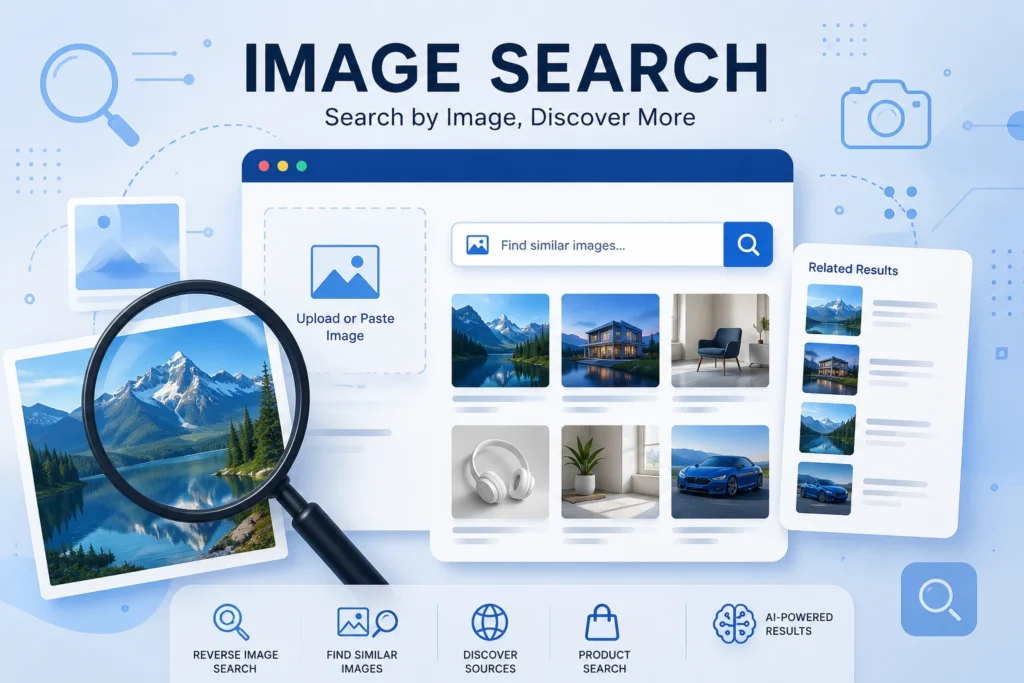
Image search is a technology that helps users find information online using images instead of text queries.
By uploading a photo, screenshot, or image URL, users can discover visually similar images, identify objects, verify image sources, or search for related content through AI-powered visual recognition systems.
Key Features of Image Search
- Reverse image search for finding original sources
- AI-powered object and face recognition
- Search using screenshots or uploaded photos
- Find similar products, places, or designs
- OCR technology to extract text from images
- Useful for SEO, research, shopping, and fact-checking
What Are Image Search Techniques?
Image search techniques are methods used to discover, identify, analyze, verify, or optimize images through search engines and AI-powered visual recognition systems.
Unlike traditional text searches, image search focuses on visual elements such as:
- Shapes
- Colors
- Objects
- Patterns
- Facial structures
- Embedded text
- Metadata
- Visual similarity
These systems use artificial intelligence and machine learning models to compare images against billions of indexed visuals online.
For example, image search techniques can help someone:
Find the original source of a viral image, identify a product from a screenshot, detect unauthorized image usage, discover higher-resolution copies, verify misinformation, or locate visually similar designs.
The applications are now widespread across industries. eCommerce companies use visual search for shopping experiences. Journalists use reverse image search for fact-checking. SEO professionals optimize images for Google visibility. Cybersecurity experts analyze metadata and manipulated visuals during investigations.
As AI search continues to evolve, image search is becoming one of the most valuable digital research skills.
Why Image Search Has Become More Important
The growth of visual-first platforms and AI-powered search experiences has changed user behavior significantly.
People increasingly prefer visual discovery over typing long search queries. Instead of describing a product, users now simply upload a photo. Instead of searching for a location by name, they scan a landmark. Instead of manually copying text from screenshots, they use AI image recognition tools.
This behavioral shift is largely driven by technologies like:
- Google Lens
- Bing Visual Search
- Pinterest Lens
- AI shopping assistants
- Multimodal search engines
Search engines are adapting accordingly. Google now integrates visual search deeply into mobile search experiences, shopping results, and AI-generated search summaries.
Visual content also plays a growing role in click-through rates. Pages with optimized and relevant images often attract more engagement than text-only content. Google Images itself generates a substantial amount of search traffic for publishers, bloggers, and online stores.
Another major reason image search matters is misinformation detection. Reverse image search has become one of the most effective ways to verify whether an image is authentic, manipulated, or taken out of context.
In 2026, image search is no longer just a convenience feature. It is becoming a core layer of how people navigate the web.
How Modern Image Search Engines Work
Most users only see the search interface, but modern image search systems rely on highly advanced AI infrastructure behind the scenes.
When an image is uploaded or indexed, search engines analyze it using several layers of recognition technology.
Computer Vision Analysis
Computer vision allows AI systems to interpret visual information similarly to human perception.
The system examines:
- Object shapes
- Edges
- Color distribution
- Spatial relationships
- Texture patterns
- Visual composition
For example, an AI system can recognize whether an image contains shoes, buildings, animals, electronics, or vehicles simply by analyzing visual structures.
This is the foundation of visual search technology.
Metadata Interpretation
Search engines also rely heavily on contextual information connected to images.
This includes:
- File names
- ALT text
- Captions
- Structured data
- Surrounding page content
- EXIF metadata
A properly optimized image provides strong contextual signals that help search engines understand relevance more accurately.
For example, a file named:
image-search-techniques-guide.jpg
provides significantly more context than:
IMG00392.jpg
Even simple optimization practices can improve image discoverability in search results.
Machine Learning Comparison Systems
AI systems compare uploaded visuals against massive image databases.
Instead of comparing every pixel directly, search engines create unique visual signatures for images. These signatures help identify:
- Exact duplicates
- Cropped variations
- Edited versions
- Similar layouts
- Related objects
- Matching products
This is why reverse image search can often locate the original source of a modified image even after filters or cropping have been applied.
Most Effective Image Search Techniques in 2026
There are many ways to search using images, but some techniques are significantly more effective depending on the goal.
Understanding when and how to use each method can dramatically improve search accuracy.
1. Keyword-Based Image Search
Traditional keyword image search is still widely used today. Users type descriptive phrases into search engines to find relevant visuals.
For example:
“modern office desk setup”
“best mountain hiking backpacks”
“minimalist website homepage design”
Search engines then display images based on metadata relevance, contextual content, user engagement signals, and image optimization.
While this method works well for inspiration and general browsing, it has limitations. Keyword-based image search struggles when users do not know how to describe what they are looking for.
This is where AI-powered visual search becomes much more useful.
2. Reverse Image Search
Reverse image search allows users to upload an image instead of typing keywords.
The system analyzes the uploaded image and attempts to find:
- Original upload sources
- Duplicate copies
- Similar images
- Edited versions
- Websites using the image
- Higher-quality variations
This technique is commonly used for fact-checking, copyright protection, and online investigations.
For example, journalists often use reverse image search to verify whether a viral image is recent or actually years old and reused in misleading contexts.
Content creators also use it to identify websites that copied their graphics without permission.
Among all image search techniques, reverse image search remains one of the most practical and widely used.
Advanced Reverse Image Search Strategies
Most people perform reverse image searches incorrectly by simply uploading screenshots directly into Google.
However, experienced researchers often use more advanced methods to improve accuracy.
One effective technique is cropping irrelevant background elements before uploading the image. Search engines perform better when the main object remains isolated and visually clear.
Using high-resolution versions also improves matching precision significantly. Low-quality compressed screenshots often reduce AI recognition accuracy.
Another important strategy is cross-platform verification. Different search engines maintain different image databases and recognition systems.
For example:
Google Lens performs exceptionally well for object recognition and OCR-based searches.
TinEye is more effective for tracing older image origins and duplicate detection.
Yandex is known for surprisingly strong facial recognition capabilities.
Pinterest Lens performs extremely well for lifestyle and aesthetic-based searches.
Using multiple tools together often produces far better results than relying on a single platform.
3. AI Visual Search and Object Recognition
AI visual search has become one of the fastest-growing areas in search technology.
Instead of matching exact copies, AI visual search attempts to understand the content inside images.
For example, users can now upload a photo of sneakers and instantly receive:
- Similar products
- Shopping recommendations
- Brand suggestions
- Related styles
- Price comparisons
This technology is heavily used in eCommerce.
Retail brands increasingly optimize product images specifically for visual search systems because modern consumers now shop visually rather than textually.
Object recognition technology also allows AI systems to identify multiple elements within a single image simultaneously.
An uploaded room photo may trigger recognition for:
- Furniture
- Lighting
- Decorations
- Wall colors
- Flooring styles
This creates highly personalized discovery experiences.
OCR Image Search Techniques
OCR, or Optical Character Recognition, is another powerful image search method.
OCR extracts readable text from images, screenshots, scanned documents, and photographs.
This allows users to search using:
- Screenshot text
- Receipts
- Presentation slides
- Infographics
- Posters
- Memes
Google Lens has dramatically improved OCR technology in recent years. Users can now copy, translate, and search text directly from images in seconds.
OCR is especially valuable for students, researchers, marketers, and professionals handling visual documents regularly.
Metadata-Based Image Search
Metadata-based image search focuses on hidden information stored within image files.
This may include:
- Camera type
- GPS coordinates
- Creation date
- Editing software
- Device details
- Copyright information
Investigators and journalists often use metadata analysis to verify image authenticity.
However, many social media platforms now strip metadata automatically during uploads for privacy reasons.
Still, original image files may retain valuable hidden information useful for verification purposes.
Best Image Search Tools in 2026
Several tools dominate the image search landscape today, but each platform has different strengths.
Google Lens
Google Lens is currently the most advanced mainstream visual search tool. It combines object recognition, OCR, shopping search, and reverse image functionality into one ecosystem.
It performs especially well for:
- Product searches
- Landmark recognition
- Real-time camera search
- Text extraction
- Shopping recommendations
Its deep integration into Android and Google Search gives it a major advantage.
TinEye
TinEye specializes in image tracking and duplicate detection.
Unlike Google Lens, TinEye focuses heavily on identifying older versions and exact image matches.
It is widely used for:
- Copyright monitoring
- Source tracing
- Duplicate detection
- Content verification
Bing Visual Search
Bing Visual Search has improved substantially in recent years, particularly for shopping-focused queries.
It performs well when identifying:
- Fashion products
- Consumer electronics
- Home decor items
- Commercial products
Pinterest Lens
Pinterest Lens focuses heavily on visual inspiration and style discovery.
It is commonly used for:
- Fashion inspiration
- Interior design
- Recipes
- Lifestyle ideas
Pinterest’s visual recommendation engine is especially strong for aesthetic matching.
Image Search Techniques for SEO
Image SEO is becoming increasingly important as visual search continues expanding.
Many websites still ignore image optimization completely, which creates opportunities for publishers willing to optimize properly.
Search engines rely heavily on image-related signals to understand context and relevance.
One of the most important elements is descriptive file naming. Generic file names provide almost no contextual information.
ALT text is equally important. It should describe the image naturally while helping search engines and accessibility systems understand the content accurately.
Image compression also matters significantly. Large images slow websites down, negatively affecting both rankings and user experience.
Modern formats like WebP and AVIF help reduce file size while maintaining quality.
Structured data adds another layer of context. Proper schema markup helps search engines associate images with products, articles, recipes, and other content types.
As AI search engines increasingly interpret visual content directly, image SEO will likely become even more influential in future rankings.
Common Image Search Mistakes
Many users fail to get accurate results because they overlook small but important optimization factors.
One common mistake is relying entirely on low-quality screenshots. Blurry images reduce recognition accuracy substantially.
Another issue is depending on only one image search engine. Different platforms often produce completely different results because they index images differently.
Many websites also make SEO mistakes by uploading uncompressed images without descriptive metadata or proper ALT text.
Overusing generic stock photography can also reduce originality signals. AI systems increasingly favor authentic and unique visual assets.
Future of Image Search Techniques
The future of image search is closely connected to multimodal AI systems.
Search engines are rapidly evolving toward experiences that combine:
- Voice input
- Visual search
- Conversational AI
- Real-time camera recognition
- Contextual recommendations
Eventually, users may no longer separate text search and image search entirely. AI systems will interpret both simultaneously.
For businesses, this means visual optimization will become just as important as traditional keyword optimization.
Brands that invest in high-quality original visuals, image SEO, structured metadata, and AI-friendly content strategies will likely gain significant visibility advantages in the coming years.
Final Thoughts
Image search techniques have evolved far beyond simple picture matching. They now sit at the center of AI-powered discovery, modern SEO, digital verification, visual commerce, and online research.
Whether you are a marketer trying to improve image visibility, a journalist verifying online claims, a creator protecting copyrighted visuals, or an SEO professional adapting to AI search, understanding these techniques provides a major competitive advantage.
As search engines continue becoming more visual and AI-driven, mastering image search optimization today can help future-proof your online visibility tomorrow.
FAQs
What are image search techniques?
Image search techniques are methods used to identify, analyze, locate, or verify images using AI systems, metadata, reverse search tools, and visual recognition technologies.
Which reverse image search tool is most accurate?
Google Lens is currently one of the most accurate tools for general visual recognition, while TinEye performs better for exact duplicate detection and source tracing.
How does AI image search work?
AI image search uses computer vision and machine learning algorithms to analyze visual patterns, objects, text, and contextual elements within images.
Can image search detect fake images?
Yes. Reverse image search can often identify older versions of manipulated or misleading images, helping users verify authenticity.
Does image optimization improve SEO?
Yes. Proper image optimization improves page speed, accessibility, Google Images visibility, and overall search performance.
Why is image search important for eCommerce?
Visual search helps users discover products faster through photos instead of text queries, improving shopping experiences and conversions.