


If you’ve spent any time learning SEO, you’ve probably heard that adding schema markup can help your website earn rich snippets in Google Search. But one question keeps coming up:
Do rich snippets actually help SEO?
The short answer is yes, but not in the way many people assume.
Rich snippets won’t automatically push your page from position 10 to position 1. However, they can improve visibility, increase click-through rates, strengthen trust, and help search engines better understand your content. In today’s AI-driven search landscape, they can also improve how your information is surfaced in AI-generated answers.
This guide explains exactly how rich snippets influence SEO, rankings, user behavior, and AI search visibility.
What Are Rich Snippets?
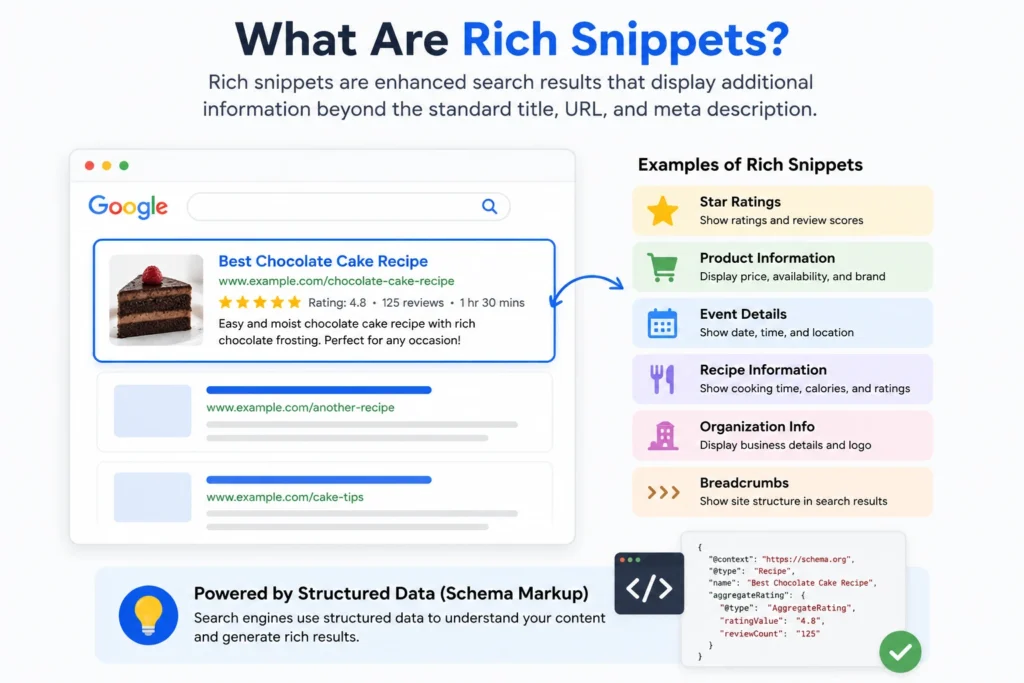
Rich snippets, also known as rich results, are enhanced search listings that display additional information beyond the standard title, URL, and meta description.
Examples include:
- Star ratings
- Product prices
- Availability status
- Recipe details
- Event information
- Breadcrumbs
- Organization details
- Review data
These enhancements are generated using structured data markup, typically based on Schema.org vocabulary.
Do Rich Snippets Directly Improve Rankings?
No.
Google has repeatedly stated that structured data itself is not a direct ranking factor. Adding schema markup does not automatically improve keyword rankings.
However, that doesn’t mean rich snippets are unimportant.
Think of them as an SEO amplifier rather than a ranking factor.
They help your existing rankings perform better by attracting more attention and generating more qualified clicks.
Quick Answer
Rich snippets help SEO indirectly, not directly.
How Rich Snippets Help SEO
Increased Click-Through Rate (CTR)
Search results with star ratings, prices, images, or other enhancements stand out from traditional listings.
Users naturally notice these results first.
A higher CTR can lead to:
- More organic traffic
- Better visibility
- Greater engagement
Many industry studies have found significant CTR improvements for rich results compared to standard listings.
Better SERP Visibility
Rich snippets occupy more space in search results.
This creates a visual advantage over competing pages.
Benefits include:
- More screen real estate
- Improved brand awareness
- Greater perceived authority
When users see additional information directly in the SERP, they are more likely to trust the result before clicking.
Improved Content Understanding
Schema markup helps search engines understand:
- Page purpose
- Entity relationships
- Product information
- Business details
- Author information
The clearer your content structure becomes, the easier it is for search engines and AI systems to interpret your page.
Do Rich Snippets Help AI Overviews?
Increasingly, yes.
AI-powered search experiences rely heavily on structured and machine-readable content.
While schema markup does not guarantee inclusion in AI Overviews, it helps systems understand:
- Questions and answers
- Products and services
- Organizations
- Reviews
- Locations
- Content relationships
Pages with clear structure and strong entity signals are generally easier for AI systems to process and reference. Recent SEO discussions increasingly view schema as an important part of AI search optimization.
Rich Snippets vs AI Overviews
Many website owners confuse these concepts.
| Rich Snippets | AI Overviews |
|---|---|
| Appear as enhanced listings | Appear as AI-generated summaries |
| Powered by schema markup | Powered by AI retrieval systems |
| Increase CTR | Increase brand visibility |
| Focus on SERP enhancements | Focus on answer generation |
| Controlled through structured data | Influenced by authority, entities, and content quality |
The strongest SEO strategy today targets both.
Types of Rich Snippets That Still Matter in 2026
Product Schema
Best for:
- E-commerce websites
- SaaS comparison pages
- Affiliate sites
Can display:
- Price
- Availability
- Ratings
Review Schema
Useful for:
- Software reviews
- Local businesses
- Product comparisons
Can display:
- Star ratings
- Review counts
Breadcrumb Schema
Helps Google understand site structure and improves navigation signals.
Organization Schema
Supports:
- Brand recognition
- Knowledge Graph connections
- Entity SEO
Local Business Schema
Essential for local SEO.
Can help search engines understand:
- Address
- Phone number
- Business hours
- Service area
What About FAQ Rich Snippets?
This is where many outdated SEO guides are wrong.
Google significantly reduced FAQ rich result visibility and now limits FAQ rich results primarily to certain authoritative sites. However, FAQ content and structured data can still help search engines understand content and support answer-focused experiences.
The lesson:
Don’t add FAQ schema just to gain SERP space.
Create FAQs because they genuinely answer user questions.
Best Practices for Rich Snippet SEO
Use Valid Schema Markup
Implement:
- JSON-LD format
- Schema.org vocabulary
- Google’s supported schema types
Focus on User Intent
Schema should describe valuable content, not compensate for weak content.
Build Entity Signals
Connect your content to:
- Authors
- Brands
- Products
- Organizations
- Locations
Entity SEO increasingly influences AI visibility.
Create Clear Answer Sections
Answer important questions directly.
This helps:
- Featured snippets
- AI Overviews
- Voice search
- ChatGPT Search
Common Mistakes to Avoid
- Using inaccurate schema
- Marking up content users cannot see
- Adding irrelevant schema types
- Overusing FAQ schema
- Ignoring entity optimization
- Focusing only on rankings instead of visibility
The Future of Rich Snippets in AI Search
As search engines continue moving toward AI-generated answers, structured data remains important.
The goal is no longer just earning a rich result.
The goal is helping search engines and AI systems understand:
- Who you are
- What your content covers
- Which entities are involved
- Why your page is trustworthy
Rich snippets, schema markup, entity SEO, and answer-focused content now work together as part of a modern AEO strategy.
So, do rich snippets help SEO?
Yes—but indirectly.
Rich snippets are not a direct ranking factor, yet they can significantly improve visibility, click-through rates, user trust, and content understanding. In the age of AI Overviews and answer engines, structured data also plays an important role in helping machines interpret and surface your content.
If you want better SEO results in 2026, focus on creating high-quality content, implementing accurate schema markup, building strong entity signals, and answering user questions clearly. Rich snippets become far more powerful when they support an overall search visibility strategy rather than serving as a standalone tactic.
People Also Ask
Do rich snippets help SEO?
Yes, rich snippets help SEO indirectly. They improve search visibility, increase click-through rates (CTR), and make listings more attractive in search results, which can lead to more organic traffic.
Are rich snippets a Google ranking factor?
No. Google has stated that structured data and rich snippets are not direct ranking factors. However, they can improve user engagement and CTR, which may positively influence overall SEO performance.
What is the difference between rich snippets and rich results?
The terms are often used interchangeably. Rich results are enhanced search listings generated from structured data, while rich snippets generally refer to the additional information displayed within those listings.
How do I get rich snippets in Google Search?
To become eligible for rich snippets, you need to implement structured data (Schema.org markup) on your website and follow Google’s rich result guidelines. Google then decides whether to display enhanced results.
Does schema markup improve SEO?
Schema markup does not directly improve rankings, but it helps search engines understand your content better. This can increase visibility, improve CTR, and support AI-driven search experiences.
Do rich snippets increase click-through rates?
Yes. Rich snippets often attract more attention because they display additional information such as ratings, prices, FAQs, or product details, which can lead to higher CTR compared to standard search listings.