


Want to know how fast you can click? A CPS test measures your mouse clicking speed by calculating how many clicks you can make per second.
CPS stands for Clicks Per Second. For example, if you make 40 clicks during a 5-second test, your CPS score is 8 CPS.
Use the CPS test above to measure your clicking speed, compare different test durations, and see whether you can improve your personal best.
What is CPS Test?
A CPS test, also called a click speed test, is an online tool that measures how quickly you can repeatedly click your mouse during a fixed period.
The test counts your clicks and calculates your average clicks per second.
The basic formula is:
CPS = Total Clicks ÷ Test Duration in Seconds
For example:
- 20 clicks in 5 seconds = 4 CPS
- 35 clicks in 5 seconds = 7 CPS
- 50 clicks in 5 seconds = 10 CPS
CPS is commonly used by gamers, particularly players who want to measure their clicking speed for games such as Minecraft. It can also be used as a simple way to test mouse input and clicking performance.
Whether you want to know how many clicks you can do with your mouse either in a second, 5 seconds, or 10 seconds, you should take time to participate in this type of test. There are so many websites that allow you to do this for free and checkcps.com is one of them with the most accurate results.
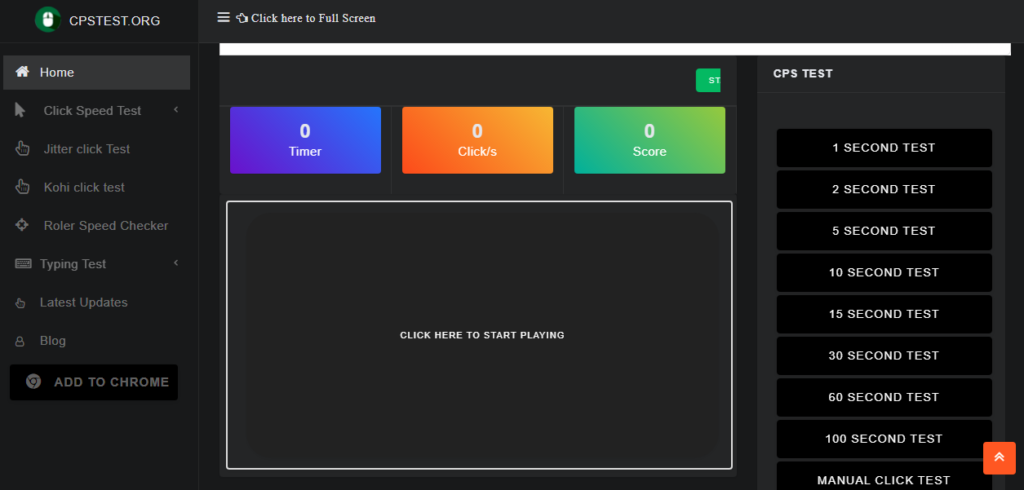
It is not only a way to calculate the number of clicks in a particular period of time, but most people take this test as a game and compete globally to break the records of each other. CPS is the magnitude of mouse clicks to a time unit (usually in seconds). The higher the rate of clicks per second, the better you can score during the test to outperform other players (who are taking the same test).
How Fast you can Click to Check your Click Speed Score?
The basic purpose of taking a CPS test is to test fingers’ speed on a mouse. It helps you find out how speedily you can click the mouse buttons while playing a game or doing a computer-related task. Most players take this test for a particular time span like 5, 10, 15, or 30 seconds. You can choose a preferred time period to check your clicking speed online.

CPS Test or Click Speed Test Game – A Challenge to Yourself
Calculating the mouse clicking speed is usually known as the ‘click speed test’. There are many websites that offers different variations (time spans) which a user can choose to take the test and find out his/her ability to click the mouse as fast as possible. CPS test is just like a time pass game where users try to score the highest score than other participants. Kohi click test is another popular method of checking the mouse clicking speed online.
Below are the simple steps that you should follow to take a click per second test online:
- Just visit a website that allows you to take CPS test online.
- Hit the ‘Click Here’ button available.
- The time will start right after your first click
- Keep clicking the mouse as fast as possible and as many times as you can.
- You will be able to see the current time and the time remaining to complete the test.
- When the time is out, you will be provided with the CPS test score.
You can switch to different time variations like 5 sec, 10 sec, 15 sec or 2o sec.
How is Click Per Second Score Calculated in CPS Test?
As it is mentioned above, the core purpose of the click speed test is to measure the CPS score. An online CPS counter records the number of mouse clicks in a particular clicking area during the set period of time. The user can also see the timer in real-time to calculate the total number of clicks done. At the end of time, the CPS score is calculated with the following formula:
Click per second (CPS) = Total Number of Clicks / Total Time in seconds.
How to Take a CPS Test?
Taking a CPS test is simple:
- Select your preferred test duration.
- Click inside the test area to begin.
- Click as quickly and consistently as you can.
- Continue clicking until the timer reaches zero.
- Check your total clicks and CPS score.
- Repeat the test if you want to improve your result.
For a useful comparison, try to use the same mouse, browser, test duration, and clicking technique during each attempt.
Tips for Preparing a CPS Test
It seems like a simple and easy test. But a user may need to consider several elements before taking the test. Internet connection is the first and foremost thing to consider. Since CPS tests are taken online, it is important to have a stable and high-speed internet connection. You should also choose a reliable website like CPStest.pro to get an accurate score.
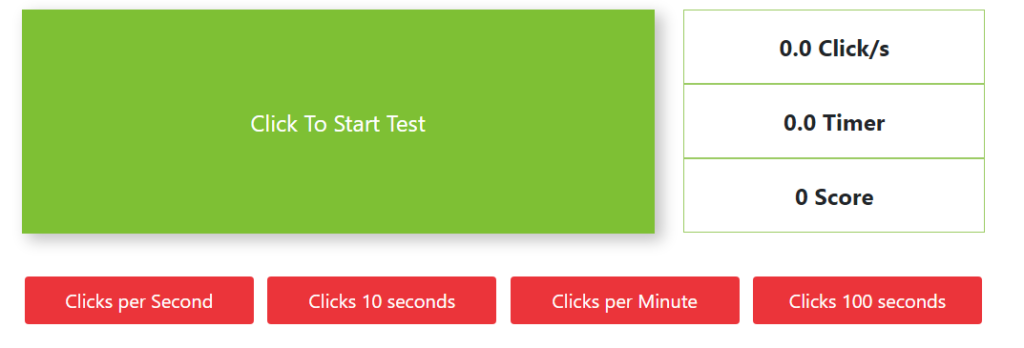
The input device is another important factor that can affect your CPS score. Before you start, make sure the mouse is working properly and well connected to the computer. Most people take this test more seriously and invest in high-quality gaming mouse to score higher. Furthermore, the player shouldn’t make any other movement during the CPS test to score higher.
Kohi Click Test
Kohi Click Test is a clicking test program used to measure the ratio of clicks per second. It is another best alternative to calculate how fast you can click the mouse within the set period of time. Minecraft server differentiates the Kohi Click Test from the CPS test method. To perform faster and outpace other participants, the Minecraft server is required to have faster-clicking speed.
Which CPS Test Duration Should You Use?
Different test durations measure slightly different aspects of clicking performance.
| Test Duration | Useful For |
|---|---|
| 1 second | Measuring short clicking bursts |
| 5 seconds | Quick CPS comparisons |
| 10 seconds | More stable click-speed testing |
| 30 seconds | Measuring sustained clicking |
| 60 seconds | Testing clicking endurance and consistency |
A 1-second test can produce a very high score because it measures only a short burst. A 30- or 60-second test is more demanding because you need to maintain your clicking speed for longer.
If you are comparing your results over time, use the same duration for each attempt.
What Is a Good CPS Score?
There is no universally accepted CPS score that officially defines a “good” clicker.
Your result can depend on several factors, including your mouse, clicking technique, test duration, browser, hardware, and individual ability.
As a general reference, you can think of CPS results like this:
| CPS | General Interpretation |
|---|---|
| Under 5 | Relatively slow clicking |
| 5–7 CPS | Common clicking range |
| 8–10 CPS | Fast clicking |
| 10–14 CPS | Very fast clicking |
| 15+ CPS | Extremely fast and often technique or hardware dependent |
These ranges are only approximate benchmarks, not official performance standards.
A higher CPS does not automatically mean better gaming performance. Accuracy, timing, movement, reaction time, and game mechanics can also matter.
What Is the Average CPS?
There is no single official average CPS that applies to everyone.
Different tests can produce different results because they may use different durations, input methods, timing systems, and scoring methods.
Your own average CPS is more useful when you want to track improvement.
For example, if your 10-second test results are:
- Attempt 1: 6.4 CPS
- Attempt 2: 6.8 CPS
- Attempt 3: 7.1 CPS
- Attempt 4: 7.5 CPS
you can use those results to monitor your progress over time.
For meaningful comparisons, keep the test conditions consistent.
CPS Clicking Techniques
The way you click can have a significant effect on your CPS score.
Normal Clicking
Normal clicking uses one finger to repeatedly press the mouse button.
It is the easiest technique to learn and generally provides good control. However, it may produce a lower maximum CPS than specialized clicking techniques.
Jitter Clicking
Jitter clicking involves rapidly moving or vibrating the clicking finger and hand while pressing the mouse button.
Some users can achieve a higher CPS with this technique, but it can be difficult to control and may become uncomfortable during extended sessions.
Butterfly Clicking
Butterfly clicking involves alternating between two fingers on the same mouse button.
Depending on the mouse and switch, this technique can produce significantly more registered clicks than traditional clicking.
However, not every mouse responds to butterfly clicking in the same way.
Drag Clicking
Drag clicking uses friction between the finger and mouse button to generate repeated switch activations.
It can produce extremely high click counts on compatible mice, but results vary considerably depending on the mouse surface, switch design, technique, and software.
A very high drag-clicking result should therefore not be compared directly with a normal-clicking score.
Why Is CPS Important in Minecraft?
CPS is particularly popular among Minecraft players because clicking speed can be relevant to certain PvP situations.
Players sometimes use CPS tests to measure how quickly they can click before practicing in-game.
However, CPS is only one part of gameplay. Higher clicking speed does not automatically make someone a better player.
Movement, aim, timing, game knowledge, positioning, connection quality, and the mechanics of a particular server or game mode can also affect performance.
Some servers or game modes may also have rules concerning automated clicking or certain clicking techniques, so players should check the applicable rules before using them.
Is a CPS Test the Same as a Click Speed Test?
Yes. In most cases, CPS test and click speed test refer to the same basic activity.
Both measure how quickly you can repeatedly click during a specified period.
The main difference is terminology:
- CPS means clicks per second.
- Click speed describes how quickly you click.
- A CPS test converts your clicking activity into a numerical clicks-per-second score.
For example, a result of 8 CPS means you registered an average of eight clicks per second during the test.
How Can You Improve Your CPS?
If you want to improve your clicking speed, focus on consistency rather than simply trying to produce the highest possible number immediately.
1. Practice Regularly
Take short CPS tests regularly using accurate online CPS test tools and compare your results using the same duration.
2. Improve Your Clicking Technique
Experiment with normal, jitter, butterfly, or other techniques to find what gives you the best balance of speed and control.
3. Use a Comfortable Mouse
A mouse that fits your hand comfortably can make repeated clicking easier. Mouse switches can also affect how clicks are registered.
4. Focus on Consistency
A single extremely high score is less useful than consistently achieving a similar result.
5. Track Your Results
Record your CPS results over time. This lets you identify whether your average speed is improving.
Do not continue clicking if your hand or fingers become painful or uncomfortable.
Does Your Mouse Affect Your CPS Score?
Yes. Your mouse can affect the number of clicks registered during a CPS test.
Factors can include:
- Mouse switch type
- Button design
- Debounce behavior
- Click actuation
- Grip
- Mouse shape
- Hardware condition
- Double-click or switch problems
Two people using different mice can therefore receive different results even if they use similar clicking techniques.
A mouse with a faulty switch may also register missed clicks or unintended double clicks, which can make test results inconsistent.
Why Does My CPS Score Change Every Time?
It is normal for your CPS score to change between attempts.
Your result can be affected by:
- Fatigue
- Clicking technique
- Test duration
- Mouse hardware
- Hand position
- Browser performance
- Timing
- Concentration
- Random variation between attempts
For this reason, one test should not necessarily be treated as your permanent CPS score.
Try several attempts under the same conditions and compare your results.
How Accurate Is an Online CPS Test?
An online CPS test is useful for measuring and comparing your clicking performance, but different testing websites may produce slightly different results.
This can happen because websites can use different timing systems and input-handling methods.
Your browser, operating system, mouse hardware, and device performance can also influence how clicks are detected.
For the most meaningful comparison, use the same CPS test and the same hardware whenever you track your progress.
CPS Test Not Working? Try These Fixes
If the CPS test is not registering clicks correctly, try these steps:
Refresh the Page
Reload the page and run the test again.
Try Another Browser
A browser extension or configuration issue can sometimes interfere with interactive web tools.
Disable Problematic Extensions
Privacy, scripting, accessibility, or input-related extensions may interfere with browser-based tests.
Check Your Mouse
Test the mouse on another website or computer to determine whether the problem is specific to the test or your hardware.
Click Inside the Test Area
Make sure your cursor is positioned over the active test area before starting.
Try a Different Device
If the test works on another device, the issue may be related to your browser, mouse, or system configuration.
Can You Take a CPS Test on Mobile?
You can measure tapping speed on some mobile devices, but a traditional CPS test is primarily designed around mouse input.
A touchscreen and a physical mouse do not generate input in exactly the same way, so mobile results should not necessarily be compared directly with desktop mouse results.
For consistent mouse-clicking measurements, use the same desktop or laptop setup for every test.
Final Thoughts
A CPS test is a simple way to measure mouse clicking speed and track your performance over time.
The most useful approach is not simply chasing the highest possible number. Use the same test duration and hardware, compare multiple attempts, and pay attention to consistency.
Whether you are testing your mouse, practicing for gaming, or simply curious about how fast you can click, a CPS test gives you a straightforward measurement of your clicking speed.
Ready to test your speed? Run the CPS test above and see how many clicks per second you can achieve.
CPS Test FAQs
What does CPS stand for?
CPS stands for Clicks Per Second. It measures the average number of clicks registered during a specific period.
How is CPS calculated?
CPS is calculated by dividing total clicks by the test duration in seconds.
CPS = Total Clicks ÷ Seconds
Is 10 CPS fast?
A 10 CPS result represents very fast clicking compared with ordinary clicking, although the meaning of the score depends on the test duration and clicking technique.
What is a good CPS?
There is no universal official “good CPS” score. A useful benchmark depends on your test duration, clicking method, hardware, and purpose.
What is the fastest clicking technique?
Techniques such as butterfly clicking and drag clicking can produce very high registered click rates on compatible mice. However, results vary significantly by hardware and technique.
Why does my CPS change between tests?
CPS can change because of fatigue, timing, technique, hardware, concentration, and other factors. Multiple tests under consistent conditions provide a better comparison.
Can a mouse affect CPS?
Yes. Mouse switches, button design, debounce behavior, hardware condition, and click registration can all influence CPS results.