



Two startups can launch in the same year, in the same industry, with similar ideas. One grows steadily. The other shuts down within two years. Often, the difference isn’t the product or the market. It’s how the founders handle money day to day. Successful startups don’t always have more funding or better luck. What they usually have are better habits.
They check their numbers often. They spend with intent. They plan for slow months and act early when something looks off. Failing startups tend to do the opposite. They avoid their finances, react too late, and make big decisions based on hope. The good news is that habits can be learned. You don’t need a finance background to build them.
This article covers the financial habits that successful startups share, the patterns that often lead to failure, and ways to make these habits part of your routine from the start.
Financial Habits That Separate Successful Startups from Failures
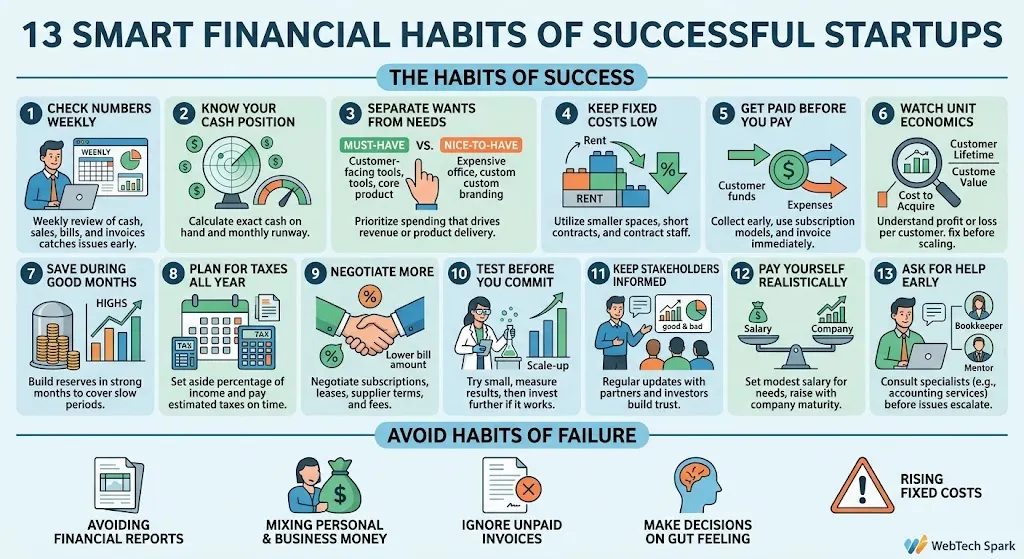
They Check the Numbers Every Week
Founders of successful startups don’t wait for a monthly report or tax season to see how things are going. They look at key numbers every week.
It doesn’t take long. Fifteen to thirty minutes is often enough to review:
- Cash in the bank
- Sales from the past week
- Upcoming bills
- Unpaid invoices
- Any unusual expenses
This habit catches problems early. A drop in sales or a spike in costs is much easier to fix after one week than after three months.
Founders who struggle often avoid looking because they’re worried about what they’ll find. But not looking doesn’t change the numbers. It just delays the fix.
They Always Know Their Cash Position
Ask a successful founder how much cash the company has, and they’ll usually know within a small range. They also know how many months that cash will last.
This matters because cash is what keeps the business alive. Revenue, profit, and growth all matter, but running out of cash ends everything.
Good founders also know what cash is coming in soon and what’s going out. That lets them plan instead of react.
They Separate Wants From Needs
Every startup has a long list of things that would be nice to have. Better equipment, a nicer office, more software, a bigger marketing budget.
Successful founders ask a simple question before spending: does this help us get customers, keep customers, or deliver our product better? If the answer is no, it waits.
Examples of wants that often come too early:
- Upscale office space
- Custom-built tools when off-the-shelf options work
- Expensive branding before the product is proven
- Large team events or perks
- Premium software plans with features nobody uses
This isn’t about being cheap forever. It’s about spending in the right order.
They Keep Fixed Costs Low
Fixed costs are the bills you pay no matter what, like rent, salaries, and long-term contracts. They’re hard to reduce quickly.
Startups that last tend to keep fixed costs low for as long as possible. They rent smaller spaces, sign shorter contracts, and use contractors before full-time staff.
That gives them room to adjust. If sales slow down, they can cut back without drastic moves. Startups with high fixed costs have fewer options when things get tough.
They Get Paid Before They Pay Out
Smart founders pay close attention to timing. They try to collect money from customers before they have to pay their own bills.
Ways they do this:
- Ask for deposits or upfront payments
- Offer small discounts for early payment
- Use subscription or retainer models
- Negotiate longer payment terms with suppliers
- Invoice right away instead of waiting
This habit improves cash flow without increasing sales. It can be the difference between a comfortable month and a stressful one.
They Watch Unit Economics
Unit economics means understanding how much you make or lose on each customer or sale.
Successful startups know:
- How much it costs to win a customer
- How much each customer pays over time
- How much it costs to serve each customer
- How long it takes to earn back what they spent to win a customer
If a startup loses money on every customer, growing faster only makes the losses bigger. Founders who track unit economics catch this early and fix pricing, costs, or marketing before scaling.
They Save During Good Months
Revenue in a startup is rarely steady. Some months are strong. Others are slow.
Founders who last treat strong months as a chance to build reserves, not an excuse to spend more. They set aside a portion of extra income so they’re ready for slower periods.
Failing startups often increase spending as soon as money comes in. When a slow month follows, they’re caught with no cushion.
They Plan for Taxes All Year
Tax bills surprise many founders. Successful ones avoid this by planning ahead.
Their habits include:
- Setting aside a percentage of income for taxes every month
- Making estimated tax payments on time
- Keeping records organized throughout the year
- Reviewing deductions and credits with a professional
- Staying on top of payroll and sales tax deadlines
Taxes aren’t optional. Planning for them turns a stressful event into a routine one.
They Negotiate More Than You’d Expect
Many costs are more flexible than they look. Smart founders ask for better terms, and often get them.
They negotiate on:
- Software subscriptions, especially annual plans
- Office leases and move-in terms
- Supplier pricing and payment terms
- Contractor rates
- Bank and payment processing fees
A few percentage points here and there add up over a year. And vendors often expect some negotiation.
They Test Before They Commit
Instead of betting big on one idea, successful startups test small first. They try a new marketing channel with a limited budget. They pilot a new service with a few customers. They hire a contractor before creating a full-time role.
Then they look at results and decide. If it works, they invest more. If it doesn’t, they’ve lost little.
Failing startups often commit large amounts of money to untested ideas because they feel sure it will work. Confidence isn’t the same as proof.
They Keep Stakeholders Informed
Founders of strong startups share regular updates with investors, partners, and key team members. That includes the good news and the bad.
This builds trust. When problems come up, people are more willing to help because they’ve been kept in the loop. Investors are also more likely to support future funding when they’ve seen honest, consistent reporting.
They Pay Themselves Realistically
Founder pay is tricky. Taking nothing for too long causes stress and poor decisions. Taking too much drains the company.
Successful founders set a modest salary that covers their basic needs and raise it as the business grows. They understand the advantages and disadvantages of entrepreneurship, including the reality that income may be uneven early on. So they plan their personal finances around it instead of hoping it works out.
They Ask for Help Early
Strong founders know what they don’t know. They bring in help before small problems turn into big ones.
That help might include a bookkeeper, an accountant, a financial advisor, or an experienced mentor. For startups in South Florida, working with an accounting service in Miami can help with bookkeeping, tax planning, and local compliance so founders can focus on growth.
Founders who wait until there’s a crisis often pay far more to fix the damage.
Habits That Often Lead to Failure
Here are patterns that show up again and again in startups that don’t make it:
- Avoiding financial reports
- Mixing personal and business money
- Spending heavily right after raising money
- Hiring too many people too soon
- Ignoring unpaid invoices
- Forgetting to plan for taxes
- Relying on one or two big customers
- Making decisions based on gut feeling instead of numbers
- Waiting until cash is almost gone to raise money
If you see several of these in your business, it’s time to make changes.
How to Build Better Habits
Changing habits takes time. Start small and build from there:
- Pick one habit to start. A weekly cash check is a good first step.
- Put it on your calendar. Treat it like a meeting you can’t miss.
- Use simple tools. Accounting software and a basic spreadsheet are enough.
- Track your progress. Notice how decisions improve when you have better information.
- Add another habit. Once the first one sticks, add the next.
- Get someone to hold you accountable. A co-founder, advisor, or accountant can help.
Final Thoughts
Startup success isn’t only about big ideas or big funding. It’s about small, steady habits. Check your numbers often, protect your cash, keep costs flexible, plan for taxes, test before you commit, and ask for help early. Founders who build these habits give their companies a much better chance of lasting. Those who skip them often find out too late that money problems don’t fix themselves.