

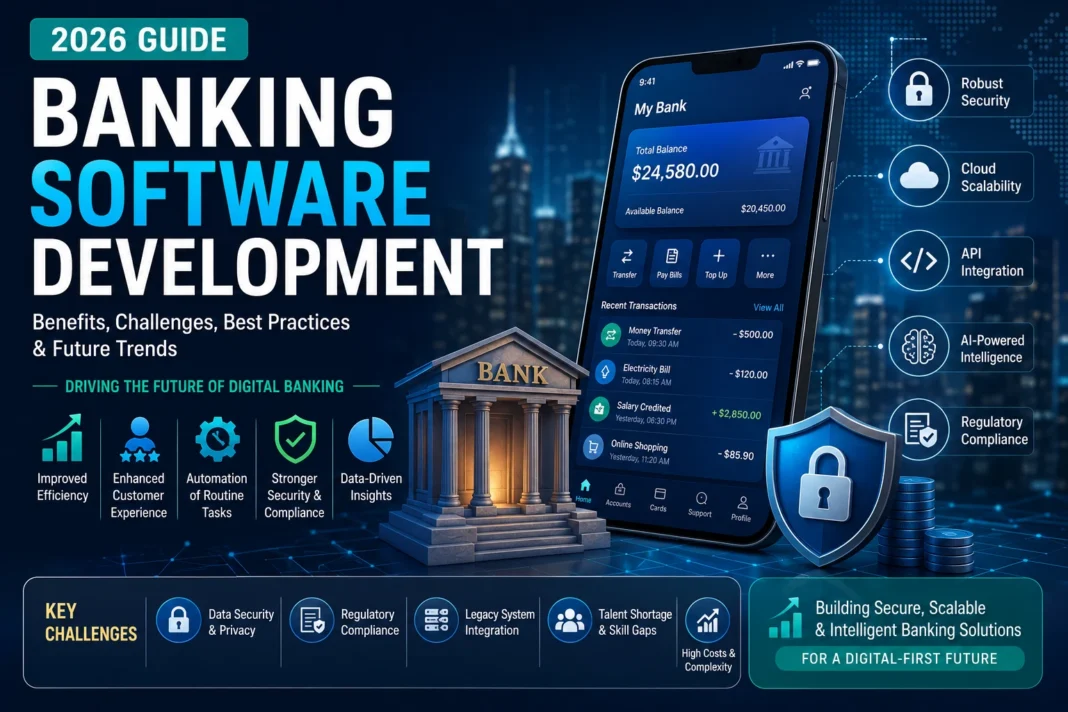

When it comes to streamlining processes, improving the customer experience, and stimulating innovation in today’s digital world, the financial sector relies heavily on software development (SWD). Whether it’s online banking or mobile payment options, banking software is essential for efficient financial management. While the benefits are substantial, software development in the sector faces a number of obstacles that must be overcome.
In this article, I will cover the issues faced by the industry and examine the pros and cons of such SWD.
What Is Banking Software Development?
Banking software development is the process of designing, building, testing, deploying, and maintaining digital applications that support financial institutions and their customers.
These solutions help banks automate operations, improve customer experiences, enhance security, and comply with financial regulations.
Common examples include:
- Mobile banking apps
- Internet banking portals
- Digital payment platforms
- Loan management systems
- Credit scoring platforms
- Core banking software
- Fraud detection systems
- Investment and wealth management applications
- Customer Relationship Management (CRM) systems
- AI-powered financial assistants
Modern banking software combines cloud computing, artificial intelligence (AI), blockchain, APIs, data analytics, and cybersecurity technologies to create secure and scalable financial ecosystems.
Why Banking Software Development Matters in 2026?
The financial industry is becoming increasingly digital. Customers demand instant services, paperless processes, and seamless digital experiences. At the same time, banks must reduce operational costs while complying with ever-evolving regulations.
A well-designed banking application enables organizations to:
- Automate repetitive workflows
- Reduce operational costs
- Improve customer engagement
- Detect fraudulent activities in real time
- Process transactions faster
- Deliver personalized financial services
- Scale digital banking operations efficiently
As digital banking adoption continues to rise globally, software has become a competitive advantage rather than just an operational necessity.
Benefits of Banking Software Development
First off, when speaking about software development, what comes to mind is how should we benefit from it! Here’s a quick rundown of SWD benefits in the financial sector.
Improved Efficiency and Productivity
Banking software development offers significant improvements in efficiency and productivity. By automating various processes, applications enable banks to handle transactions quickly, accurately, and securely. Manual tasks, such as data entry and reconciliation, can be replaced with automated systems, freeing up human resources to focus on more complex and value-added activities.
Key Benefits
- Faster processing times
- Lower operational costs
- Reduced paperwork
- Improved productivity
- Better resource utilization
Enhanced Customer Experience
One of the key advantages of fintech app development is the ability to provide customers with seamless and personalized experiences. Modern software solutions enable banks to offer online and mobile banking services, allowing customers to access their accounts, make transactions, and receive real-time notifications conveniently. This enhanced accessibility and convenience contribute to higher customer satisfaction and loyalty.
Why It Matters
Banks with superior digital experiences often enjoy:
- Higher customer retention
- Increased engagement
- Better app ratings
- Faster issue resolution
- Stronger brand reputation
Automation of Routine Tasks
Banking software can automate routine tasks like loan application processing, account opening, and transaction verifications. This automation reduces the chances of errors and speeds up the overall process.
Automation significantly improves areas such as:
- Loan processing
- Compliance verification
- Customer onboarding
- Payment approvals
- Risk assessment
- Document management
By eliminating repetitive manual work, banks can improve efficiency while reducing operational expenses.
Enhanced Security Measures
The development of robust banking software includes stringent security measures to protect sensitive customer data. Features like multi-factor authentication, encryption, and secure communication protocols ensure that customer information remains safe from unauthorized access or data breaches. With advanced security measures in place, customers can have confidence in the system, which strengthens their trust and loyalty.
Integration of Financial Services
Banking SWD allows for the integration of various financial services into a single platform. This integration enables customers to access a range of services, including banking, investment, insurance, and wealth management, all from one application. Such comprehensive solutions provide convenience to customers and encourage them to engage more deeply with the bank’s offerings.
Challenges in Banking Software Development
Data Security and Privacy
It has become increasingly difficult to provide banking software development services that adequately protect customer data in light of the proliferation of cyber threats and data breaches. In order to prevent theft or misuse of customer information, banks must establish stringent security measures and adhere to regulatory regulations. Continuous monitoring, upgrades, and rigorous security mechanisms are essential when creating and maintaining secure software systems.
Regulatory Compliance
The banking industry is heavily regulated, and compliance with regulatory standards is essential for developers. Adhering to regulations such as KYC (Know Your Customer) and AML (Anti-Money Laundering) requires the integration of compliance features within banking software. Developers need to stay updated with the ever-changing regulations and ensure that the program meets the necessary compliance requirements.

Legacy System Integration
Many banks still rely on legacy systems that may lack compatibility with modern solutions. Integrating new banking software with existing infrastructure can be a complex and time-consuming process. Legacy systems often have outdated technologies, and limited interoperability, and may require data migration or system upgrades. Overcoming these challenges requires careful planning and implementation to ensure a seamless integration process.
Rapid Technological Advancements
The banking industry is witnessing rapid technological advancements, such as artificial intelligence, machine learning, and blockchain. Keeping up with these advancements and incorporating them into banking software can be challenging. Software developers need to continuously update their skills and knowledge to leverage emerging technologies effectively and stay ahead of the competition.
Skill Gap and Talent Acquisition
Finding skilled professionals with expertise in banking software development can be a challenge for banks. The demand for experienced developers, data analysts, and cybersecurity experts in the banking sector often surpasses the available talent pool. Banks must invest in training programs, partnerships with educational institutions, and competitive hiring practices to bridge the skill gap and attract top talent.
Essential Technologies Used in Banking Software Development
Modern banking applications rely on a combination of advanced technologies to deliver secure, scalable, and intelligent financial services.
| Technology | Purpose |
| Artificial Intelligence | Fraud detection, chatbots, personalization |
| Machine Learning | Credit scoring and predictive analytics |
| Cloud Computing | Scalability and infrastructure |
| Blockchain | Secure transactions and smart contracts |
| APIs | Open banking and third-party integrations |
| Big Data | Customer insights and analytics |
| DevSecOps | Secure software delivery |
| Microservices | Modular application architecture |
| Containers (Docker/Kubernetes) | Deployment and scalability |
| Robotic Process Automation | Process automation |
Best Practices for Banking Software Development
Building successful banking software requires more than strong programming skills. Organizations must balance innovation, compliance, security, and user experience throughout the software development lifecycle.
Follow these proven best practices:
Adopt Security by Design
Security should be integrated into every stage of development rather than added after deployment.
Use Agile Development
Agile methodologies and CI/CD tools allow banks to deliver features faster while responding quickly to changing business requirements.
Invest in Automated Testing
Continuous testing improves software quality while reducing release risks.
Implement DevSecOps
Integrating development, security, and operations creates faster and more secure release cycles.
Build Cloud-Native Applications
Cloud infrastructure improves scalability, resilience, disaster recovery, and operational efficiency.
Prioritize API-First Development
APIs enable seamless integration with fintech partners and third-party financial services.
Focus on Customer Experience
Every feature should simplify banking for customers while maintaining security and compliance.
Future Trends in Banking Software Development
The future of banking will be increasingly driven by intelligent automation and AI-powered services.
Key trends expected to shape banking software in 2026 and beyond include:
- Generative AI-powered banking assistants
- Hyper-personalized financial recommendations
- Embedded finance
- Banking-as-a-Service (BaaS)
- Open Banking ecosystems
- Blockchain-powered payments
- Real-time fraud detection using AI
- Cloud-native core banking platforms
- Passwordless authentication
- Green and sustainable fintech solutions
Banks that embrace these innovations will be better positioned to meet evolving customer expectations and maintain a competitive edge.
Conclusion
Banking software development provides several benefits to both banks and customers. However, the development process comes with its own set of challenges, such as data security, regulatory compliance, legacy system integration, rapid technological advancements, and talent acquisition. Addressing these challenges is crucial for successful SWD in the banking industry, and banks must prioritize them to deliver reliable, secure, and innovative solutions.
FAQs
Is banking software development expensive?
The cost of banking software development can vary depending on the complexity of the project and the features. While there are initial investment costs, the long-term benefits and cost savings often outweigh the expenses.
How does banking software improve customer experience?
Banking software enables customers to access their accounts, make transactions, and receive real-time notifications conveniently. This accessibility and convenience contribute to a more seamless and personalized customer experience.
What are the risks associated with banking software development?
Risks in banking software development include data breaches, non-compliance with regulatory standards, challenges in integrating legacy systems, keeping up with rapid technological advancements, and the availability of skilled professionals.
How can banks ensure data security in software development?
Banks can ensure data security in software development by implementing robust security measures such as multi-factor authentication, encryption, and secure communication protocols. Regular monitoring, updates, and compliance with regulatory requirements are also essential.
What steps can banks take to address the talent acquisition challenges?
Banks can address the talent acquisition challenges by investing in training programs, partnering with educational institutions, and adopting competitive hiring practices to attract skilled professionals in banking software development.