


Continuous Integration and Continuous Deployment (CI/CD) have become the backbone of modern software delivery. In 2026, teams demand faster pipelines, stronger security, and seamless cloud-native integration. Whether you’re a startup building mobile apps or an enterprise running Kubernetes clusters, the right CI/CD tool can make or break your workflow.
In this blog post, I have listed the 30 best CI/CD Tools for developers in 2026.
What are CI/CD Tools and Why They are Important?
CI/CD (Continuous Integration and Continuous Deployment) tools are used in software development to automate and streamline the process of building, testing, and deploying software applications.
CI/CD tools help in achieving faster and more reliable software releases by automating repetitive tasks and reducing the chances of human error. They typically include features like code repositories, build automation, automated testing frameworks, and deployment automation. Popular CI/CD tools include Jenkins, GitLab CI/CD, Travis CI, CircleCI, and Azure DevOps, among others.
These 30 best CI/CD tools for 2026 are right here and may help you make this crucial decision.
Why CI/CD Matters in 2026?
- Speed: Automates builds, tests, and deployments.
- Reliability: Reduces human error with repeatable pipelines.
- Security (DevSecOps): Integrates vulnerability scanning into workflows.
- Scalability: Supports hybrid and multi-cloud environments.
- Innovation: AI-driven pipelines predict failures and optimize builds.
30 Best CI/CD Tools in 2026
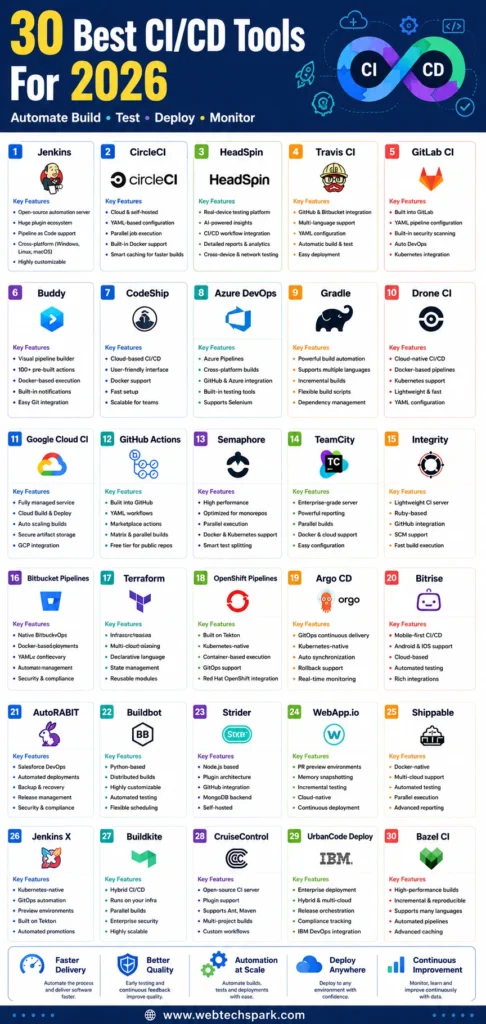
1. Jenkin
The automation server Jenkins is an open-source CI/CD tool written in Java. It is a cross-platform tool that uses DSL. Jenkins has been designed in such a way that it can handle a single CI server to an entire CD hub.
Key Features
- Open-source automation server with a large plugin ecosystem.
- Supports Continuous Integration (CI) and Continuous Deployment (CD).
- Compatible with Windows, Linux, and macOS.
- Integrates with Git, Docker, Kubernetes, Maven, and many DevOps tools.
- Enables pipeline automation using Groovy-based Pipeline as Code.
- Highly customizable for projects of any size.
2. CircleCI
CircleCI accomplishes the goal by compiling multiple languages on several operating systems. This tool creates its pipelines with the help of a simple custom YAML syntax.
Key Features
- Fast cloud-based and self-hosted CI/CD platform.
- Simple YAML configuration for pipeline creation.
- Supports parallel job execution for quicker builds.
- Works with Docker, Kubernetes, and major cloud providers.
- Built-in caching improves build performance.
- Integrates seamlessly with GitHub and Bitbucket.
3. HeadSpin
HeadSpin helps in CI/CD by providing developers with a comprehensive testing platform that integrates with their existing workflows, allowing faster feedback, consistency across environments, and comprehensive reporting. This helps to ensure that the app is functioning as expected and reduces the risk of issues being introduced into production.
Key Features
- Real-device testing platform for web and mobile applications.
- Integrates with existing CI/CD workflows.
- Provides AI-powered performance insights.
- Offers detailed test reports and analytics.
- Supports automated testing across multiple devices and networks.
- Helps identify production issues before deployment.
Read Also: Tips to Optimize Angular Application that Increases Website Speed
4. TravisCI
Regarding open-source or enterprise projects, TravisCI is one of the best CI/CD systems hosted on GitHub or BitBucket. Developed on Ruby and supporting 3rd party languages, such as Java, C#, Python, and Julia, TravisCI provides its services on its self-hosted platform.
Key Features
- Cloud-hosted CI/CD platform for open-source and private repositories.
- Native integration with GitHub and Bitbucket.
- Supports multiple programming languages.
- YAML-based configuration simplifies setup.
- Automatically builds and tests every code commit.
- Easy deployment to cloud platforms.
5. GitLab CI
Integrated with GitLab, GitLab CI combines valuable items such as code reviews and CI/CD on a single platform. It also offers the developers APIs, fulfilling the need for extensive product integration. This tool needs a Git repository for the codebase and a YAML file in the root directory.
Key Features
- Built directly into GitLab.
- Complete DevSecOps lifecycle management.
- Pipeline configuration using
.gitlab-ci.yml. - Built-in security scanning and code quality analysis.
- Auto DevOps for faster deployments.
- Supports Kubernetes and cloud-native workflows.
6. Buddy
Buddy offers the project managers access to a big pot of pre-built activities that can be organized according to their needs and takes the building CI/CD pipelines to a whole new level. It uses channels for development, continuous testing, and release so that its users can see that the rates of post-deployment failure drop significantly.
Key Features
- Visual drag-and-drop pipeline builder.
- Over 100 pre-built automation actions.
- Fast Docker-based execution.
- Supports continuous deployment to cloud platforms.
- Built-in monitoring and notifications.
- Easy integration with GitHub, GitLab, and Bitbucket.
7. CodeShip
When in need of version control and access to a hosted version for a CI/CD environment, CodeShip is the way to go. Not only does it offer a user-friendly interface, but the establishment of CI/CD is achieved in a matter of minutes with CodeShip.
Key Features
- Cloud-based CI/CD platform.
- Quick setup with intuitive interface.
- Docker support for custom environments.
- Automatic testing and deployment.
- Secure encrypted environment variables.
- Scalable for small and enterprise teams.
8. Azure DevOps
Developers can use Azure DevOps to create a facile CI/CD pipeline. Armed with trailblazing features that accelerate the software development course, it can also execute Selenium tests.
Key Features
- Complete DevOps suite from Microsoft.
- Azure Pipelines for CI/CD automation.
- Supports Windows, Linux, and macOS.
- Integrates with GitHub and Azure services.
- Built-in testing, package management, and project tracking.
- Supports Selenium and automated testing frameworks.
9. Gradle
Gradle gives the developers the power to construct management and testing automation services on its open-source CI/CD platform.
Key Features
- Powerful build automation tool.
- Supports Java, Kotlin, Android, C++, and Groovy.
- Incremental builds improve performance.
- Highly customizable build scripts.
- Integrates with Jenkins, GitHub Actions, and other CI tools.
- Dependency management included.

10. Drone CI
When needing a cloud-native CI/CD tool and the power of scalability, Drone CI is a powerful tool to come across. This tool separates each pipeline into its Docker container, downloadable at runtime.
Key Features
- Cloud-native CI/CD platform.
- Every pipeline runs inside Docker containers.
- Lightweight and highly scalable.
- Supports Kubernetes deployments.
- YAML-based configuration.
- Native Git integration.
11. Google Cloud CI
Enabling the development of a scalable and reliable application by harnessing the power of IaaS, PaaS, and SaaS, Google Cloud CI stands out in this long list of tools that help with continuous testing and monitoring.
Key Features
- Fully managed CI/CD services.
- Integrates with Google Cloud Platform.
- Supports Cloud Build and Cloud Deploy.
- Automatic scaling for build workloads.
- Secure artifact storage.
- Easy deployment to GKE and Cloud Run.
12. GitHub Actions
GitHub Actions is the perfect tool for beginners. It gives a free tier and simplifies the creation of complicated processes. GitHub runners can also use GitHub Actions to create parallel workflows that are complete and declarative for multiple purposes.
Key Features
- Built directly into GitHub repositories.
- Workflow automation using YAML.
- Marketplace with thousands of reusable actions.
- Supports matrix builds and parallel jobs.
- Free tier available.
- Native GitHub integration.
13. Semaphore
For robust and dynamic support in mono repo projects that works alongside Travis CI, GitHub, and CircleCI, Semaphore is a forerunner.
Key Features
- High-speed CI/CD platform.
- Optimized for monorepositories.
- Supports Docker and Kubernetes.
- Parallel execution for faster pipelines.
- Smart test splitting.
- Easy integration with GitHub.
14. TeamCity
TeamCity allows everyone to set up a pipeline in an instant. It offers wide-ranging development processes on its CI/CD platform for continuous testing, continuous monitoring, and Automated testing.
Key Features
- Enterprise-grade CI/CD server.
- Powerful build history and reporting.
- Extensive plugin ecosystem.
- Parallel build execution.
- Supports Docker and cloud deployments.
- Easy pipeline configuration.
15. Integrity
Integrity is a CI server that runs on Ruby and is compatible with GitHub. Its users can utilize SCM tools by emulating their repositories.
Key Features
- Lightweight Ruby-based CI server.
- GitHub integration.
- Supports multiple SCM tools.
- Simple project configuration.
- Fast build execution.
- Easy setup for Ruby projects.
16. Bitbucket CI
One of the top CI/CD tools, Bitbucket CI, allows users to put in a push and pull request. This task triggers an automatic build run by the CI service that makes bugs visible early in the process before time runs out.
Key Features
- Native CI/CD for Bitbucket repositories.
- Docker-based builds.
- YAML configuration.
- Integrated deployment pipelines.
- Automatic testing on commits.
- Secure environment variables.
17. Terraform
Terraform aids developers by managing changes in resources related to the cloud from a central location and maintains the app’s framework with the help of code.
Key Features
- Infrastructure as Code (IaC).
- Multi-cloud provisioning.
- Declarative configuration language.
- State management.
- Reusable infrastructure modules.
- Version-controlled infrastructure deployments.
18. Openshift Pipeline
Openshift Pipeline is based on Tekton, which integrates effortlessly with the development tools of Red Hat to deliver an across-the-board CI/CD environment.
Key Features
- Built on Tekton.
- Kubernetes-native CI/CD.
- Container-based pipeline execution.
- Open-source automation.
- GitOps support.
- Tight integration with Red Hat OpenShift.
19. Argo
Argo CD is a GitOps tool that is the heart of Argo. It specializes in CD mechanisms for Kubernetes-based systems by accentuating declaratory and version-controlled app settings.
Key Features
- GitOps continuous delivery.
- Kubernetes-native deployment tool.
- Automatic application synchronization.
- Rollback support.
- Declarative configuration management.
- Real-time deployment monitoring.
20. Bitrise
Notable for its mobile-first skills for continuous testing, continuous monitoring, and automated testing, Bitrise is a cloud-based CI/CD tool that doesn’t need any additional kit.
Key Features
- Mobile-first CI/CD platform.
- Supports Android and iOS development.
- Cloud-hosted infrastructure.
- Automated app testing.
- Parallel builds.
- Hundreds of integrations available.
21. AutoRABIT
When developers require a complete CD suite, AutoRABIT can be opted for to fasten the creation process. This tool was developed explicitly for Salesforce.
Key Features
- Designed specifically for Salesforce DevOps.
- Automated deployment pipelines.
- Backup and recovery tools.
- Compliance monitoring.
- Release management automation.
- Security and quality analysis.
22. Buildbot
Buildbot is a python-based platform that gives users an edge on CI testing. It accomplishes its tasks by emulating the behavior of a task scheduling system that queues, executes jobs, and then finishes reports.
Key Features
- Python-based automation framework.
- Highly customizable pipelines.
- Distributed build architecture.
- Supports multiple platforms.
- Automated testing and reporting.
- Flexible scheduling system.
23. Strider
A Node.js and JavaScript creation, Strider’s plugin ecosystem is just as robust as that of Jenkins. The backend of this tool uses the MongoDB database.
Key Features
- Open-source Node.js CI server.
- Plugin-based architecture.
- GitHub integration.
- MongoDB backend.
- Self-hosted deployment.
- Supports multiple programming languages.
24. WebApp.io
Previously known as LayerCI, WebApp.io facilitates the usage of memory snapshotting methods during testing.
Key Features
- Preview environments for every pull request.
- Memory snapshotting technology.
- Fast incremental testing.
- Cloud-native infrastructure.
- Continuous deployment automation.
- GitHub integration.
25. Shippable
A top CI/CD tool, Shippable helps develop new software versions that are delivered on time and are bug-free. It is well known for its compatibility with Cucumber, GitHub, Docker, Slack, and many more.
Key Features
- Docker-native CI/CD pipelines.
- Multi-cloud deployment support.
- Automated testing workflows.
- Integrates with GitHub, Docker, Slack, and Kubernetes.
- Parallel pipeline execution.
- Advanced reporting dashboard.
26. Jenkins X
By utilizing the power to produce previews on pull requests and using Git as an authoritative source, Jenkins X is one of the forerunners in this list. Using pipeline-based automation adds support and newer features to the Tekton project.
Key Features
- Kubernetes-native CI/CD.
- GitOps workflow automation.
- Preview environments for pull requests.
- Built on Tekton.
- Automated promotion pipelines.
- Cloud-native application deployment.
27. Buildkite
Developers using on-premises infrastructure to run quick, safe, and scalable CI/CD pipelines should opt for Buildkite. Executing multiple agents and building tasks parallely is only available here.
Key Features
- Hybrid CI/CD platform.
- Runs builds on your own infrastructure.
- Parallel execution with multiple agents.
- Enterprise-grade security.
- Supports Docker and Kubernetes.
- Scalable for large development teams.
28. CruiseControl
CruiseControl comes with multiple plugins and a CI server supported by an active community of users. It allows the simultaneous development of numerous projects on a single host machine. Its compatible builders are Ant, Maven, and many more.
Key Features
- One of the earliest CI servers.
- Extensive plugin support.
- Supports Ant, Maven, and other build tools.
- Simultaneous project builds.
- Customizable build workflows.
- Open-source and community-driven.
29. UrbanCode
UrbanCode is the brainchild of IBM due to its CD solution UrbanCode Deploy which automates the deployment of applications in an environment.
Key Features
- Enterprise application deployment automation.
- Supports hybrid and multi-cloud environments.
- Automated release management.
- Environment modeling.
- Compliance and audit tracking.
- Seamless integration with IBM DevOps tools.
30. Bazel CI
Bazel CI allows developers to set up automated build and test pipelines triggered by code changes, pull requests, or other events. The pipeline includes steps for building, testing, and deploying the software and generating reports and notifications. Bazel CI supports various programming languages, including Java, C++, Python, and Go.
Key Features
- High-performance build and test automation.
- Incremental and reproducible builds.
- Supports Java, C++, Python, Go, and more.
- Automated pipelines triggered by commits and pull requests.
- Scalable for large codebases.
- Advanced caching for faster builds.
Final Words
When choosing a CI/CD tool that covers the unique requirements to accomplish continuous testing, continuous monitoring, and Automated testing, this list can give users a deep awareness of CI/CD tools and testing automation.